
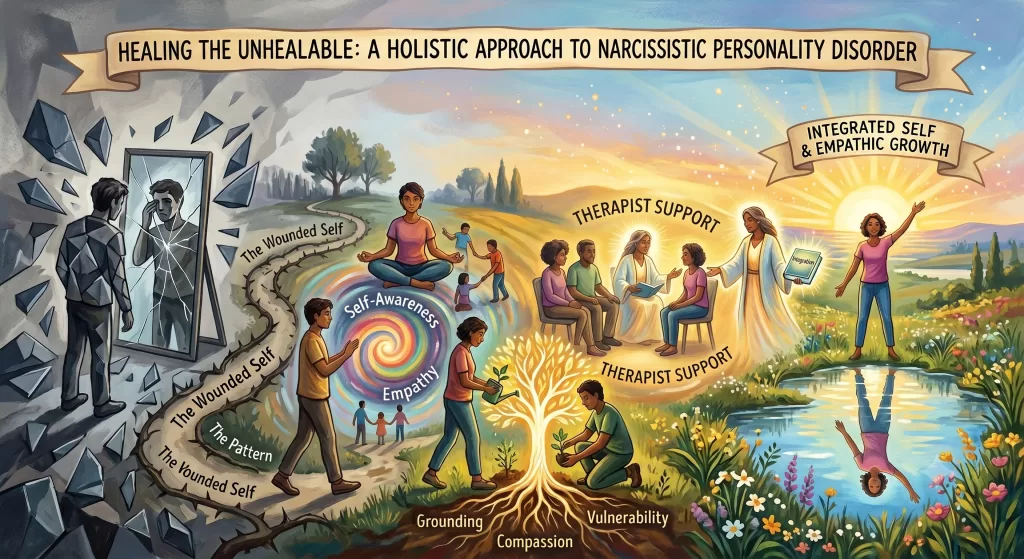
Narcissistic Personality Disorder (NPD) is one of the most misunderstood mental health conditions. In popular culture, the term “narcissist” is often used casually to describe someone who is arrogant, selfish, or manipulative. However, from a clinical psychology perspective, NPD is far more complex and deeply rooted in emotional wounds, attachment disruptions, nervous system dysregulation, and early relational experiences.
As clinical psychologists, it is important to look beyond the behaviours and understand the human pain beneath them. Healing from NPD is possible, contrary to general belief, but it requires deep psychological work, emotional accountability, nervous system healing, and a therapeutic space that supports both insight and transformation.
What is Narcissistic Personality Disorder?

Narcissistic Personality Disorder is a personality disorder characterised by patterns of grandiosity, excessive need for admiration, emotional defensiveness, lack of empathy, and fragile self-esteem hidden beneath a seemingly confident exterior.
Individuals with NPD may:
- Crave validation and recognition
- Struggle with criticism or rejection
- Experience difficulty maintaining healthy relationships
- Alternate between superiority and deep insecurity
- Use control, manipulation, gaslighting or emotional withdrawal as defence mechanisms
- Have difficulty accessing vulnerable emotions such as shame, grief, fear, or helplessness
Contrary to common belief, narcissism is not simply “too much self-love.” In many cases, it reflects a fragmented sense of self that developed as a survival adaptation during childhood.
The Psychological and Nervous System Roots of NPD
From a psychodynamic, attachment-based, and somatic perspective, narcissistic patterns often emerge from childhood environments where emotional needs were neglected, invalidated, inconsistently met, or tied to performance and achievement.
Some common developmental experiences include:
- Childhood emotional neglect
- Excessive criticism or unrealistic expectations
- Lack of secure emotional attachment
- Conditional love based on success or image
- Family systems that discouraged emotional vulnerability
- Intergenerational trauma and unresolved family dynamics
- Chronic emotional stress during formative years.
Over time, the child learns to suppress authentic emotions and create a “false self” designed to gain approval, avoid shame, or maintain emotional survival.
What many people do not realise is that these defences are not only psychological — they are also physiological. The nervous system learns to stay in protective states such as hypervigilance, emotional shutdown, control, dissociation, or defensive reactivity.
Underneath narcissistic defences, there is often:
- Deep emotional loneliness
- Fear of abandonment
- Unprocessed shame
- Chronic nervous system activation
- Difficulty trusting intimacy
- A wounded inner child seeking safety and validation
The Role of Somatic Work in Healing Narcissistic Patterns
Somatic therapy emphasises the connection between the mind, body, emotions, and nervous system. Because trauma and emotional wounds are often stored in the body, healing cannot always occur through insight alone. It’s important to understand that the nervous system does not comprehend spoken language; it only understands the language of touch. Somatic work involves using touch to help regulate the nervous system.
Many individuals with narcissistic defences are highly disconnected from their bodily sensations and emotional vulnerability. They may intellectualise emotions, suppress feelings, or remain in chronic states of tension and control.
Somatic work helps individuals reconnect with their internal emotional experience safely and gradually.
Somatic approaches may include:
- Breathwork
- Nervous system regulation techniques
- Grounding practices
- Body awareness exercises
- Trauma-release techniques
- Mindfulness and embodiment work
These practices help clients:
- Develop emotional safety within the body
- Reduce chronic stress and hypervigilance
- Increase emotional tolerance
- Reconnect with suppressed emotions
- Improve self-awareness and presence
- Feel safer in vulnerability and intimacy
- Shift from survival responses toward regulation and connection
In many cases, profound emotional healing begins when the body no longer feels constantly threatened.
The Role of Family Constellations in Healing Narcissistic Patterns
Family Constellations offers a powerful systemic lens for understanding narcissistic dynamics. Developed by Bert Hellinger, Family Constellations explores how unresolved trauma, emotional entanglements, exclusions, and inherited patterns within family systems continue to influence present-day behaviours and emotional functioning.
In many cases, narcissistic patterns are not only individual psychological adaptations but also systemic responses rooted in family history.
For example:
- A child may unconsciously carry unresolved shame from previous generations
- Emotional disconnection may have existed across the family lineage
- Love may have been associated with performance or sacrifice
- Vulnerability may have been unsafe within the family system
- Family trauma may have created emotional survival roles
Family Constellation therapy helps individuals observe these unconscious dynamics with greater awareness and compassion.
Family Constellations can support individuals with narcissistic traits by helping them:
- Recognise inherited emotional burdens
- Understand unconscious loyalty patterns
- Release identification with dysfunctional family roles
- Reconnect with authentic emotions
- Restore healthier emotional boundaries
- Develop greater compassion for self and others
- Access deeper emotional truths beneath defensive patterns
This work can gently uncover the hidden emotional pain beneath narcissistic defences, creating opportunities for emotional integration and healing.
The Benefits of Combining Psychotherapy, Somatic Work, and Family Constellations
Healing NPD becomes more powerful when multiple therapeutic dimensions are integrated together.
While psychotherapy focuses on conscious awareness, emotional processing, behaviour patterns, and relational healing, somatic work addresses nervous system regulation and stored emotional stress within the body. Family Constellations adds a systemic and intergenerational perspective that reveals inherited emotional patterns and family dynamics.
Together, these approaches create a deeply holistic healing process.
Psychotherapy Helps By:
- Building emotional insight
- Strengthening self-awareness
- Developing coping and relational skills
- Supporting accountability and behavioural change
- Creating long-term emotional regulation
Somatic Work Helps By:
- Regulating the nervous system
- Releasing stored emotional stress
- Increasing emotional safety within the body
- Supporting embodiment and presence
- Reducing defensive reactivity and emotional shutdown
Family Constellations Helps By:
- Revealing hidden systemic patterns
- Accessing unconscious family dynamics
- Releasing inherited emotional burdens
- Facilitating deeper emotional and energetic shifts
- Expanding compassion and belonging
Together, they help individuals heal not only cognitively, but also emotionally, physically, and systemically.
A Compassionate Perspective on Healing NPD
Healing from narcissistic patterns requires courage. It involves facing painful emotions that may have been avoided for years — shame, grief, rejection, abandonment, helplessness, and vulnerability.
Therapy is not about labeling someone as “bad” or “toxic.” It is about understanding the protective mechanisms that developed in response to emotional pain and helping individuals build healthier ways of relating to themselves and others.
With the right therapeutic support, genuine transformation is possible.
Through psychotherapy, somatic healing, inner child work, and systemic approaches such as Family Constellations, individuals can gradually move away from defensive survival patterns and toward authenticity, emotional connection, accountability, nervous system regulation, and inner stability.
Healing begins when the need to protect the false self becomes less powerful than the desire to reconnect with the authentic self.