Is BPD Really A Disorder or A Nervous System Shaped By Family Dynamics
In many Indian homes, survival is praised.
Silence is maturity.
Adjustment is love.
But what happens to the child who feels everything deeply?
What happens to the nervous system that grows up in emotional unpredictability — where love exists, but emotional safety feels conditional?
For many individuals diagnosed with Borderline Personality Disorder (BPD), the story is not about being “too much.”
It is about being shaped by relational environments where belonging required self-suppression.
At Blooming Mind, we view BPD not as a character flaw — but as a deeply relational, nervous-system adaptation rooted in family dynamics.
And healing must honour that context.
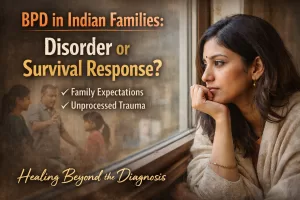
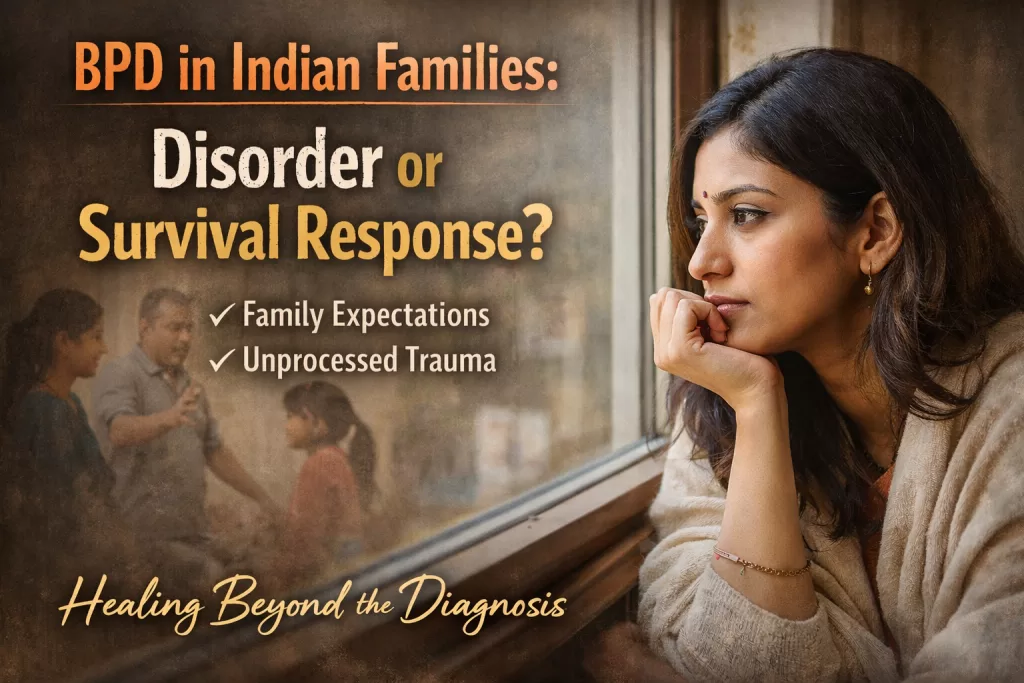
Understanding BPD in Indian Family Systems

Indian families are often loving, protective, and deeply bonded. But they are also:
- Hierarchical
- Duty-bound
- Emotionally enmeshed
- Resistant to discussing trauma
- Structured around obedience and sacrifice
Children quickly learn invisible rules:
- Don’t express too much emotion.
- Don’t challenge elders.
- Don’t burden the family.
- Adjust. Always adjust.
For a sensitive child, this creates an internal conflict:
“I need connection… but I must silence myself and earn it.”
Over time:
- Boundaries feel unsafe.
- Separation feels like abandonment.
- Identity becomes role-based instead of authentic.
- Emotions build without healthy release.
This is fertile ground for what later gets labelled as BPD.
A Nervous System Perspective on BPD
While BPD is a recognised clinical diagnosis, many of its symptoms can also be understood as adaptive nervous system responses to chronic relational stress.
When attachment feels unpredictable, the body adapts.
Common patterns include:
- Fight → emotional outbursts, impulsivity
- Flight → anxiety, overthinking, restlessness
- Freeze → numbness, dissociation, shutdown
- Fawn → people-pleasing, over-functioning
These are not personality defects.
They are survival strategies.
The nervous system learned:
“Connection is important — but it may not be safe.”
Healing must therefore go beyond cognitive insight.
It must involve both the body and the family system.
Why Traditional Talk Therapy Alone Often Isn’t Enough
In Indian contexts, trauma is rarely just individual.
It is relational and intergenerational.
Consider:
- A grandmother who never processed grief after Partition.
- A mother who was taught to suppress emotion to be “good.”
- A father carrying silent financial stress and emotional rigidity.
- A child who becomes the emotional mediator at age 9.
The child absorbs what the system cannot metabolise.
That is why at Blooming Mind, we integrate talk therapy with:
- Family Constellations Therapy
- Somatic Therapy
Together, they address both the systemic and the embodied roots of BPD.
What Is Family Constellations Therapy?
Family Constellations is a systemic therapeutic approach that reveals hidden intergenerational patterns and emotional entanglements within families.
It helps uncover:
- Unresolved grief
- Parentification
- Emotional exclusions
- Gender-based suppression
- Invisible loyalty binds
In Indian families — where duty often overrides individuality — these patterns are powerful.
Constellations allow clients to:
- See parents as humans shaped by their own trauma
- Release inherited emotional burdens
- Restore healthy relational order
- Experience belonging without self-erasure
Importantly — it does this without blame or confrontation.
What Is Somatic Therapy?
Somatic therapy works directly with the nervous system.
Instead of analysing emotions endlessly, it helps you:
- Track body sensations
- Regulate emotional intensity
- Complete unfinished survival responses
- Rebuild internal safety
Trauma is not only remembered — it is stored.
Especially in BPD, where emotional regulation feels overwhelming, somatic work creates stability from within.
How This Combined Approach Heals BPD
1️⃣ Healing Attachment Wounds Without Blame
In many Indian households, parents loved deeply — but lacked emotional attunement.
Constellations help you:
- Acknowledge emotional gaps without villainising caregivers
- Separate your pain from inherited trauma
- Restore the natural flow: parents give, children receive
Somatic therapy allows the body to actually feel this shift — not just understand it intellectually.
2️⃣ Releasing Intergenerational Emotional Burdens
Many individuals with BPD unconsciously carry:
- A mother’s silent grief
- A father’s suppressed anger
- A family’s unspoken shame
- The role of “keeping everyone together”
Constellations identify what doesn’t belong to you.
Somatic therapy supports your body in letting it go.
Clients often report:
- Reduced emotional reactivity
- Greater identity clarity
- Less relational panic
- A feeling of lightness
3️⃣ Regulating Emotional Intensity
In Indian culture, especially for women, emotions are often labelled:
- “Too sensitive”
- “Overreacting”
- “Unstable”
But emotional surges are often the release of years of suppression.
Somatic therapy teaches:
- How to feel emotions in tolerable doses
- How to exit overwhelm safely
- How to self-regulate without shutting down
Emotions stop being frightening — and start becoming manageable.
4️⃣ Reclaiming Identity Beyond the “Good Child” Role
Many Indian children unconsciously become:
- The peacemaker
- The achiever
- The emotional caretaker
- The silent absorber
Eventually, the question becomes:
“Who does my family need me to be?”
Instead of:
“Who am I?”
Constellations combined with somatic work allow you to:
- Step out of inherited roles
- Return burdens to where they belong
- Reclaim your authentic identity
- Belong without self-sacrifice
This is where real healing begins.
Is This Approach Right for You?
This integrative healing path may resonate if you:
- Fear abandonment intensely
- Feel overwhelmed in close relationships
- Experience emotional highs and lows that feel uncontrollable
- Struggle with identity outside family expectations
- Feel responsible for others’ emotional stability
- Carry guilt when choosing yourself
You are not “too much.”
Your nervous system adapted to survive.
And it can learn safety again.
A Culturally Sensitive Path to Healing BPD in India
At Blooming Mind, we honour:
- The depth of Indian family bonds
- The reality of intergenerational trauma
- The complexity of attachment wounds
- The intelligence of the nervous system
We do not pathologise intensity.
We understand it.
Through the integration of Family Constellations and Somatic Therapy, we help clients move toward:
- Emotional regulation
- Secure attachment
- Identity clarity
- Relational stability
- Nervous system resilience
Healing does not require rebellion.
It requires understanding — and a safe space to experience it.
🌿 Ready to Begin?
If this resonates with you, we invite you to explore therapy with Blooming Mind.
You deserve a connection without collapse.
Closeness without fear.
Belonging without losing yourself.
Book a consultation today.